

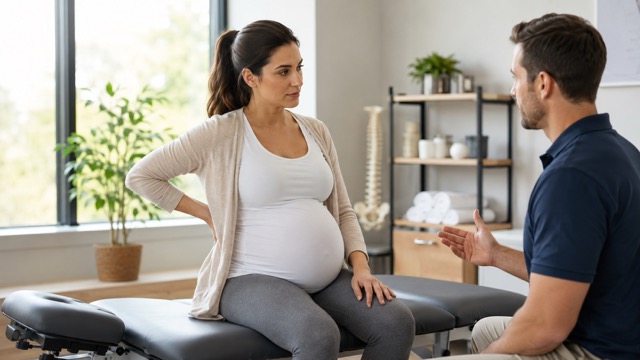
During pregnancy, the body changes significantly in a relatively short period of time. The abdomen grows, body weight increases, and the way you stand, walk, sit and sleep changes. As a result, many pregnant women experience back or pelvic pain.
Symptoms may develop in the lower back, pelvis, groin, pubic area or around the tailbone. Pain between the shoulder blades, neck and shoulder tension, and headaches are also common.
These complaints are usually not dangerous, but they can have a significant impact on everyday activities such as walking, climbing stairs, working, sleeping and turning over in bed.
At Cornerstone Chiropractie in Dongen, we assess what may be contributing to your symptoms and whether chiropractic care during pregnancy is appropriate for your situation.
Back and pelvic pain during pregnancy usually does not have one single cause. It is often the result of a combination of hormonal changes, postural adaptations and altered loading of muscles and joints.
During pregnancy, hormone levels change. The body produces increased amounts of hormones such as relaxin. This hormone helps connective tissue and ligaments become more flexible, allowing the body to adapt to pregnancy and childbirth.
This does not automatically mean that the pelvis becomes truly unstable. Most women adapt well to these changes. In some women, however, altered joint movement, muscle loading and increased sensitivity may contribute to pain around the lower back and pelvis.
As the abdomen grows, the body’s centre of gravity shifts forwards. The body adapts its posture accordingly.
The curve in the lower back may increase, while the upper back and shoulders may be loaded differently. The muscles around the back, abdomen, hips and pelvis therefore need to work together in a different way.
Standing, sitting, walking or lifting for longer periods may require more effort than before pregnancy.
The way you move often changes during pregnancy. You may exercise less, walk differently or sleep in the same position for longer periods. Fatigue, stress, previous back problems, physically demanding work and caring for other children may also play a role.
Back and pelvic pain therefore usually develops as a result of several contributing factors.
Pregnancy-related complaints can vary greatly between women and between different stages of pregnancy.
Common symptoms include:
The term pelvic instability is still commonly used, but it can create a misleading impression. It suggests that the pelvis is loose, misaligned or damaged. In most cases, this is not what is happening.
A more accurate description is pregnancy-related pelvic girdle pain.
Not all pain radiating into the buttock or leg is automatically sciatica either. Radiating pain can have several different causes, which is why a careful assessment is important.
A chiropractor can assess whether your complaints may be related to the movement and loading of the spine, pelvis, hips or surrounding muscles.
During an initial consultation, we discuss:
This is followed by a physical examination. Depending on your symptoms, we may assess spinal and pelvic movement, muscle function, posture, coordination and nerve function.
Not every complaint during pregnancy is suitable for chiropractic treatment. If we suspect that the symptoms may have a medical or obstetric cause, we will advise you to contact your midwife, GP or gynaecologist.
Chiropractic treatment can be used during different stages of pregnancy, provided there are no medical reasons not to treat.
Treatment is adapted to:
There is no standard treatment that is carried out in exactly the same way for every pregnant woman.
At Cornerstone Chiropractie, we use a special pregnancy cushion where appropriate. This cushion supports the abdomen and may make it possible to lie comfortably on your stomach. Treatment can also be carried out while lying on your side or back, or while seated.
Depending on the findings from the assessment, treatment may include:
The aim is not to “realign” the pelvis or create perfect posture.
Treatment focuses on reducing symptoms, making movement easier and supporting the body as it adapts to the changing physical demands of pregnancy.
The response to treatment varies from person to person. Some women notice improvement quickly. In others, several factors may be involved and a combination of treatment, movement, load management and cooperation with other healthcare professionals may be needed.
Complete rest is usually not the best solution for movement-related back and pelvic complaints. In many cases, it is better to remain active within your own limits.
The following advice may help:
Pain does not automatically mean that damage is occurring. At the same time, it is not sensible to repeatedly ignore severe or worsening pain. Try to find a balance between movement, load and recovery.
Back and pelvic complaints during pregnancy are often movement-related. However, pain can sometimes indicate a problem that requires medical assessment.
Contact your midwife, GP or gynaecologist if you experience:
Chiropractic care is not a substitute for medical or obstetric assessment in these situations.
After childbirth, a new phase begins. The body needs time to recover from pregnancy and delivery. At the same time, a different pattern of physical load develops through feeding, lifting, carrying and caring for the baby.
Sleep deprivation, fatigue, a caesarean section, vaginal delivery or complications around childbirth may also influence recovery.
Complaints that may occur after childbirth include:
Reduced trunk stability does not simply mean that the abdominal muscles are “too weak”. Recovery depends on cooperation between breathing, the abdominal muscles, back muscles, diaphragm and pelvic floor.
In some cases, support from a pelvic health physiotherapist can therefore be a valuable addition.
Chiropractic care after childbirth may focus on complaints involving the back, pelvis, neck and shoulders.
We take into account:
Treatment may include adapted chiropractic techniques, mobilisation, muscle treatment, exercises and practical advice about feeding, lifting and carrying.
Trying to return to your previous exercise or activity level as quickly as possible is not always sensible after childbirth. Recovery varies greatly between women and should be adapted to the birth, your symptoms, physical condition, sleep and daily demands.
Every pregnancy and every recovery period is different. That is why we do not only look at where you feel pain, but also at how you move, your daily physical load and other factors that may be contributing to your symptoms.
Are you experiencing back, pelvic, neck or shoulder complaints during or after pregnancy? At Cornerstone Chiropractie in Dongen, we first carry out a careful assessment to determine what may be contributing to your symptoms and whether chiropractic care is appropriate for your situation.
Treatment is always adapted to the stage of pregnancy or your recovery after childbirth.
If your symptoms do not fit with a typical movement-related complaint, we will advise you to contact your midwife, GP or another appropriate healthcare professional.
Treatment may be possible during different stages of pregnancy. The techniques and treatment positions are adapted to the stage of pregnancy, your symptoms and your overall health.
Chiropractic care may help some women experience less pain and move more comfortably. Results vary and depend on factors such as the cause, duration and severity of the symptoms.
A special pregnancy cushion may allow you to lie comfortably on your stomach. If this does not feel comfortable, treatment can also be carried out while lying on your side or back, or while seated.
Usually not. The term pelvic instability is often used to describe pregnancy-related pelvic girdle pain, even though the pelvis is generally not actually loose or unstable.
This depends on the birth, your symptoms and your recovery. If you have concerns, complications, a caesarean section or severe symptoms, it is sensible to speak to your midwife or doctor first.
